
Provider Map

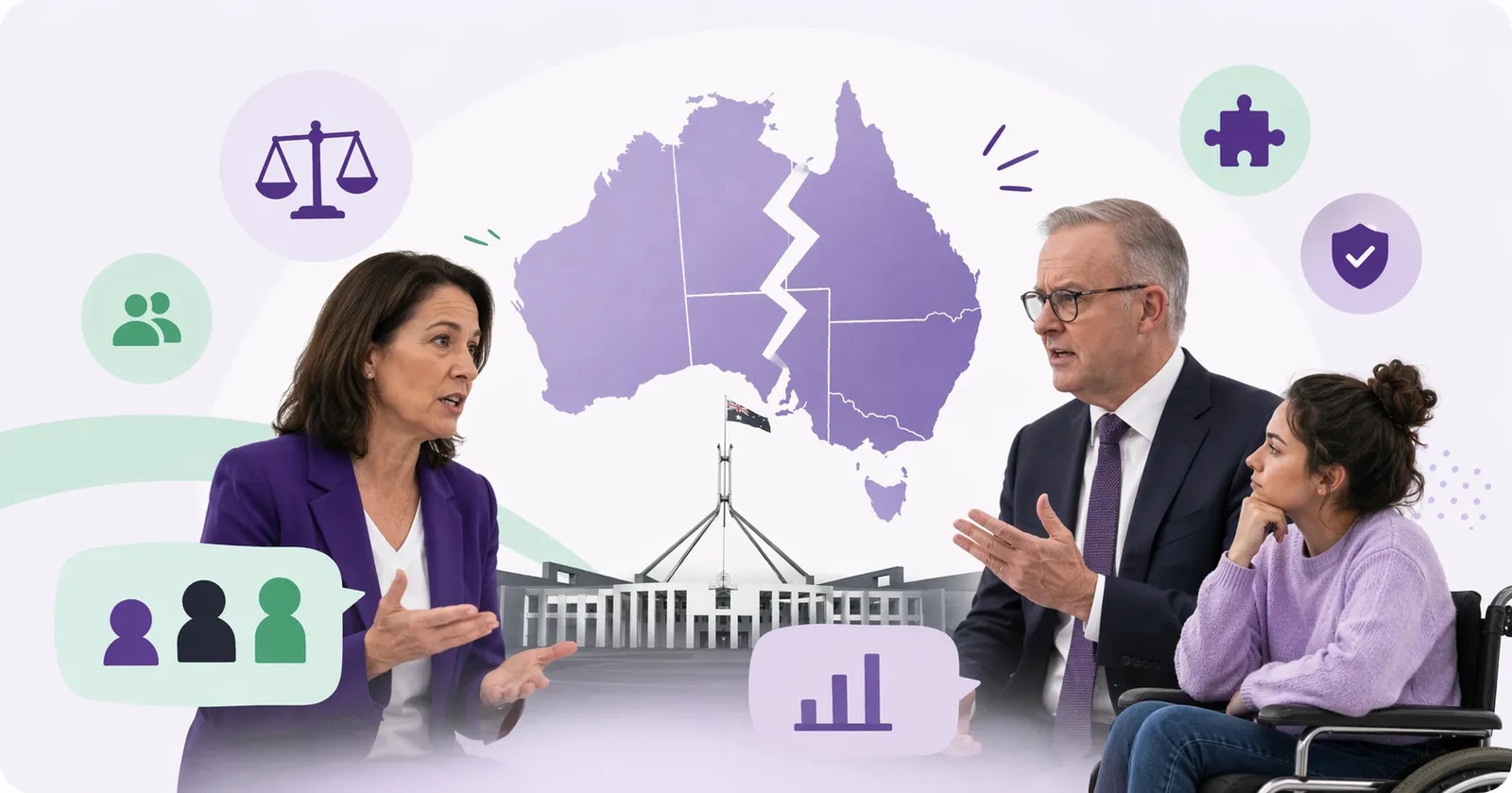
NDIS States Revolt: Why the Albanese Government Faces a Federal-State Showdown

States warn they cannot deliver like-for-like services for NDIS participants being removed. What does the federal-state showdown mean for disability support in Australia?

News10 min read
NDIS States Revolt: Why the Albanese Government Faces a Federal-State Showdown

TL;DR

  • State and territory disability ministers have warned they cannot deliver "like-for-like services" for the 240,000+ NDIS participants expected to be shifted off the scheme by 2031 [1].
  • The states say they were not meaningfully consulted on the NDIS overhaul and accuse the federal government of a "broader shift away from shared governance" [2].
  • The Senate inquiry into the NDIS cuts was extended in June 2026 after being labelled "ridiculous and disrespectful" by advocacy groups [3].
  • Mark Butler dismissed calls to reconsider the scale of cuts, insisting the plan keeps "people with disability at its centre" [1].
  • The showdown exposes a critical gap in Australia's disability support system: there is no agreement on who pays when the NDIS shrinks.

The States' Warning: "We Cannot Deliver"

In a joint submission to the Senate inquiry in June 2026, state and territory disability ministers issued an unprecedented warning to the Albanese government: they are not equipped to absorb the flood of participants the NDIS reforms would push out onto state systems [1].

The submission — representing every state and territory — was direct and unsparing. Disability ministers said they had not been "meaningfully consulted" on the NDIS overhaul and were deeply concerned about the unilateral powers given to the federal NDIS minister, which they said signalled a "broader shift away from shared governance" [1].

"Without a careful, coordinated approach that aligns these changes with broader improvements across the disability support system, there is a significant risk that people with disability will end up in hospitals or other settings that are inappropriate and unable to meet their needs, or have no access to services at all."

— State and territory disability ministers, Senate inquiry submission, June 2026 [1]

The ministers were equally blunt about the practical reality:

"States and territories are not in a position, and have made no agreement, to deliver like-for-like services to people who are exited from the NDIS."

— State and territory disability ministers, Senate inquiry submission, June 2026 [1]

This is not a technical negotiation over funding formulas. It is a fundamental disagreement about who is responsible for people with disabilities in Australia — and right now, the answer is: no one is ready to take them.

The Numbers: 240,000 Participants at Risk

The NDIS currently supports more than 700,000 Australians at an annual cost exceeding $50 billion [4]. The government's reform plan, announced in May 2026, aims to reduce that growth rate to 2% annually over the forward estimates — a target that requires removing an estimated 240,000 to 241,000 participants from the scheme over four years [1][5].

The shift from a diagnosis-based model to a functional capacity assessment means many people currently receiving lower-intensity NDIS supports will no longer qualify. The government argues this is necessary to restore the scheme's sustainability. The Grattan Institute, which broadly supports reform, agrees that cost growth is unsustainable but has repeatedly warned about the risks of hasty implementation:

"There is a risk of hitting the growth target while missing the point: relying on blunt cost reductions that worsen outcomes for participants while underlying design issues take more time to resolve."

— Grattan Institute, April 2026 [4]

Just 42% of Australians believe the NDIS offers value for money, compared to 79% for Medicare [4]. That statistic underlines the political urgency behind the reforms — but also the fragility of the scheme's social licence. If participants are cut without proper alternatives, public trust could erode further.

Shared Governance Under Threat

The NDIS was founded on a principle of shared governance between the Commonwealth and the states. When the scheme launched in 2013, states agreed to contribute funding and co-manage the system in exchange for the Commonwealth taking over disability services that had historically been a patchwork of state-run programs.

The NDIS Amendment (Securing the NDIS for Future Generations) Bill 2026 changes that equation. The bill gives the federal minister broad new powers to:

  • Directly commission certain supports, starting with support coordinators and plan managers [5]
  • Set planning rules that shape participant budgets [5]
  • Expand mandatory provider registration to more support categories [5]

State ministers argue these powers amount to a federal takeover that weakens the collaborative framework the NDIS was built on. They warn that cost-shifting to state health, education, and justice systems will follow — and those systems "are not equipped for increased demand" [1].

The Grattan Institute has noted that one of the NDIS's core design flaws is the lack of meaningful supports outside the scheme [4]. Creating a comprehensive "foundational supports" system would take years, not months. Yet the government plans to both start cutting NDIS participants and launch foundational supports on the same day: 1 January 2028 [5].

The Senate Inquiry: Extended but Not Stopped

The Senate inquiry examining the NDIS bill was originally scheduled to report quickly, but intense pressure from disability advocates, legal bodies, and crossbench MPs forced two extensions [3].

The inquiry heard harrowing testimony about the real-world impact of the proposed cuts. Submissions warned that planned 20% reductions to social and community participation budgets would increase isolation, segregation, and create "unsafe situations" for participants [1].

The Queensland Law Society recommended more time for consultation, arguing the compressed timeline risked producing flawed legislation [6]. The Australian Council of Social Service (Acoss) and peak disability bodies made similar submissions.

Despite the opposition, Health Minister Mark Butler dismissed calls to extend the inquiry further and reaffirmed his commitment to passing the legislation before parliament rose for the winter break on 2 July 2026 [1].

Political Fallout: Coalition and Greens Join the Fight

The federal-state showdown has scrambled Australia's usual political alignments.

Shadow NDIS minister Melissa McIntosh has emerged as an unexpected critic, stating the NDIS must be sustainable but "in the rush of cutting expenditure, we cannot forget that there are human lives at the other end" [1].

The Greens, who supported the government's tax overhaul in June 2026, have been vocal critics of the NDIS cuts. Greens senators called the reforms "immoral" and said they were being rushed through without adequate scrutiny [1].

The Coalition finds itself in an awkward position: it supports NDIS sustainability in principle but has warned it does not back the bill in its current form, raising concerns about transparency and the pace of change [7].

For Labor, passing the NDIS bill is critical to its budget strategy. Treasurer Jim Chalmers has flagged NDIS savings as "easily the most important" part of budget repair [8]. But every week of delay costs money — and every concession to the crossbench or the states reduces the savings target.

What This Means for Participants and Families

If you or a family member is an NDIS participant, the federal-state standoff has concrete implications:

1. The cuts are still coming, but the timeline is uncertain The government remains committed to reform, but Senate delays and state opposition may force amendments that slow implementation or soften eligibility changes [3].

2. State services are not a guaranteed safety net The states have explicitly said they cannot match NDIS supports. If you lose NDIS eligibility, there is no guarantee that state-based health, education, or disability services will fill the gap [1].

3. Foundational supports are still being designed The alternative system meant to replace NDIS help for lower-need participants does not yet exist in any detail. The Grattan Institute described launching it by January 2028 as "a tall ask" [4].

4. Advocacy matters now more than ever Peak disability bodies, state ministers, and crossbench senators are all pushing for changes to the bill. Written submissions to the Senate inquiry and direct contact with MPs can still influence the final shape of the legislation [3].

5. Document everything If your plan is up for reassessment in 2026–2027, keep detailed records of your functional needs, medical reports, and therapy notes. The transition to a functional capacity framework means evidence of daily impact will be critical.


FAQ

Q: Why are states saying they can't deliver like-for-like services? State disability ministers argue their health, education, and justice systems are not funded or equipped to absorb tens of thousands of people losing NDIS supports. They say the federal government has not properly consulted them or secured agreements on funding [1].

Q: Will the NDIS bill pass in its current form? Unlikely. The Coalition, Greens, and crossbench have all raised serious concerns. The government may need to accept amendments — particularly around transitional supports, the pace of implementation, and the minister's powers over planning rules [3][7].

Q: Who is most at risk of losing NDIS eligibility? People with lower-intensity or less visible disabilities, including those receiving social and community participation supports. Children with developmental delays and people with psychosocial disabilities are also flagged as high-risk groups [4][5].

Q: What are foundational supports? They are a proposed system of information, referral, and lower-level disability assistance outside the NDIS, meant for people who no longer qualify for the scheme. The system is scheduled to launch on 1 January 2028 but is still being designed [4][5].

Q: How can participants prepare for potential eligibility changes? Speak to your support coordinator or Local Area Coordinator about what the functional capacity assessment means for you. Document your needs, engage with the consultation process, and connect with advocacy organisations like People with Disability Australia (PWDA) or state-based peak bodies [3][5].


References

[1] The Guardian, "We can't deliver 'like-for-like-services' for people kicked off the NDIS, states warn Albanese government," 11 June 2026. By Sarah Basford Canales, Dan Jervis-Bardy, Benita Kolovos and Caitlin Cassidy. Available at: https://www.theguardian.com/australia-news/2026/jun/11/states-cant-deliver-like-for-like-services-people-kicked-off-ndis-warn-albanese-government

[2] ABC News, "State disability ministers lash NDIS overhaul," 10 June 2026. By Nas Campanella, Evan Young and Mary Lloyd. Available at: https://www.abc.net.au/news/2026-06-10/state-disability-ministers-lash-ndis-overhaul/103462158

[3] ABC News, "'Ridiculous and disrespectful': Inquiry into NDIS cuts extended," 23 June 2026. By Nas Campanella and Evan Young. Available at: https://www.abc.net.au/news/2026-06-23/inquiry-into-ndis-cuts-extended/103462158

[4] Grattan Institute, "The NDIS reform package is a step forward," 22 April 2026. Available at: https://grattan.edu.au/news/the-ndis-reform-package-is-a-step-forward/

[5] The Guardian, "New NDIS eligibility rules will cut 241,000 participants from scheme in four years," 28 May 2026. By Dan Jervis-Bardy. Available at: https://www.theguardian.com/australia-news/2026/may/28/new-ndis-eligibility-rules-will-cut-241000-participants-from-scheme-in-four-years

[6] Queensland Law Society, "QLS recommends more time for critical consultation on NDIS reform Bill," 18 June 2026. Available at: https://www.qlsproctor.com.au/qls-recommends-more-time-critical-consultation-ndis-reform-bill

[7] The Australian, "Coalition threatens to derail Labor's NDIS reform over transparency fears," 16 June 2026. By Sarah Ison. Available at: https://www.theaustralian.com.au/nation/politics/coalition-threatens-to-derail-labors-ndis-reform-over-transparency-fears/news-story/

[8] The Guardian, "States on edge about NDIS cuts as Chalmers flags they will be 'easily the most important' part of budget savings," 20 April 2026. By Tom McKendrick. Available at: https://www.theguardian.com/australia-news/2026/apr/20/states-on-edge-about-ndis-cuts-as-chalmers-flags-they-will-be-easily-the-most-important-part-of-budget-savings